Stats
Actions
Available In
Tags

Govern Claude Code development with hook-enforced dual review (Claude + Codex), state-machine gated workflows, and fail-closed safety — covering bug fixes, feature development, code review, testing, documentation, security audits, and git operations.
Architecture design expert. Synthesizes code analysis, tech-spec context, and architecture advice into structured architecture documents with component diagrams, data flows, and architecture decisions.
PM/CTO executive summary expert. Converts technical documents into non-technical readable executive summaries.
Cleanup refactoring expert. Simplifies code, eliminates duplication, preserves behavior.
Codex architecture consulting expert (third brain). Uses Codex CLI to obtain architecture advice and integrates dual perspectives.
Codex implementation expert. Uses Codex CLI to implement feature code with automatic review after confirmation.
Architecture design and documentation. Produces 3-architecture.md with component diagrams, data flow, integration points, and architecture decisions. Reads existing tech-spec as input. Use when: designing system architecture, documenting component interactions, creating architecture docs, producing 3-architecture.md. Not for: tech spec writing (use tech-spec), code implementation (use feature-dev), architecture consulting only (use codex-architect).
Context-aware Q&A with auto context gathering. Use when: user has a quick question about codebase, git history, rules, docs, or skills during development. Not for: code changes (use feature-dev), code review (use codex-review-fast), deep research (use deep-research), full code trace (use code-explore). Output: structured answer with source attribution.
Industry best practices conformance audit with mandatory adversarial debate. Produces audit artifact: verdict (OK/WARN/FAIL) + gap roadmap + debate proof. Use when: auditing current implementation against industry standards, checking compliance with best practices, benchmarking implementation quality, verifying a codebase meets a standard. Not for: broad research/discovery without audit target (use /deep-research), code review (use /codex-review), architecture design (use /codex-architect).
Bug fix workflow. Use when: fixing bugs, resolving issues, regression fixes. Not for: new features (use feature-dev), understanding code (use code-explore). Output: fix + regression test + review gate.
Bump package and plugin version in sync. Updates package.json, .claude-plugin/plugin.json, and install-state manifest to the same version. Use when: user says 'bump version', 'update version', '更新版本', '版本 +1', or /bump-version
Executes bash commands
Hook triggers when Bash tool is used
Modifies files
Hook triggers on file write and edit operations
Own this plugin?
Verify ownership to unlock analytics, metadata editing, and a verified badge. GitHub access is read-only (username + org membership).
Sign in to claimOwn this plugin?
Verify ownership to unlock analytics, metadata editing, and a verified badge. GitHub access is read-only (username + org membership).
Sign in to claimBased on adoption, maintenance, documentation, and repository signals. Not a security audit or endorsement.
Uses power tools
Uses Bash, Write, or Edit tools
Uses power tools
Uses Bash, Write, or Edit tools
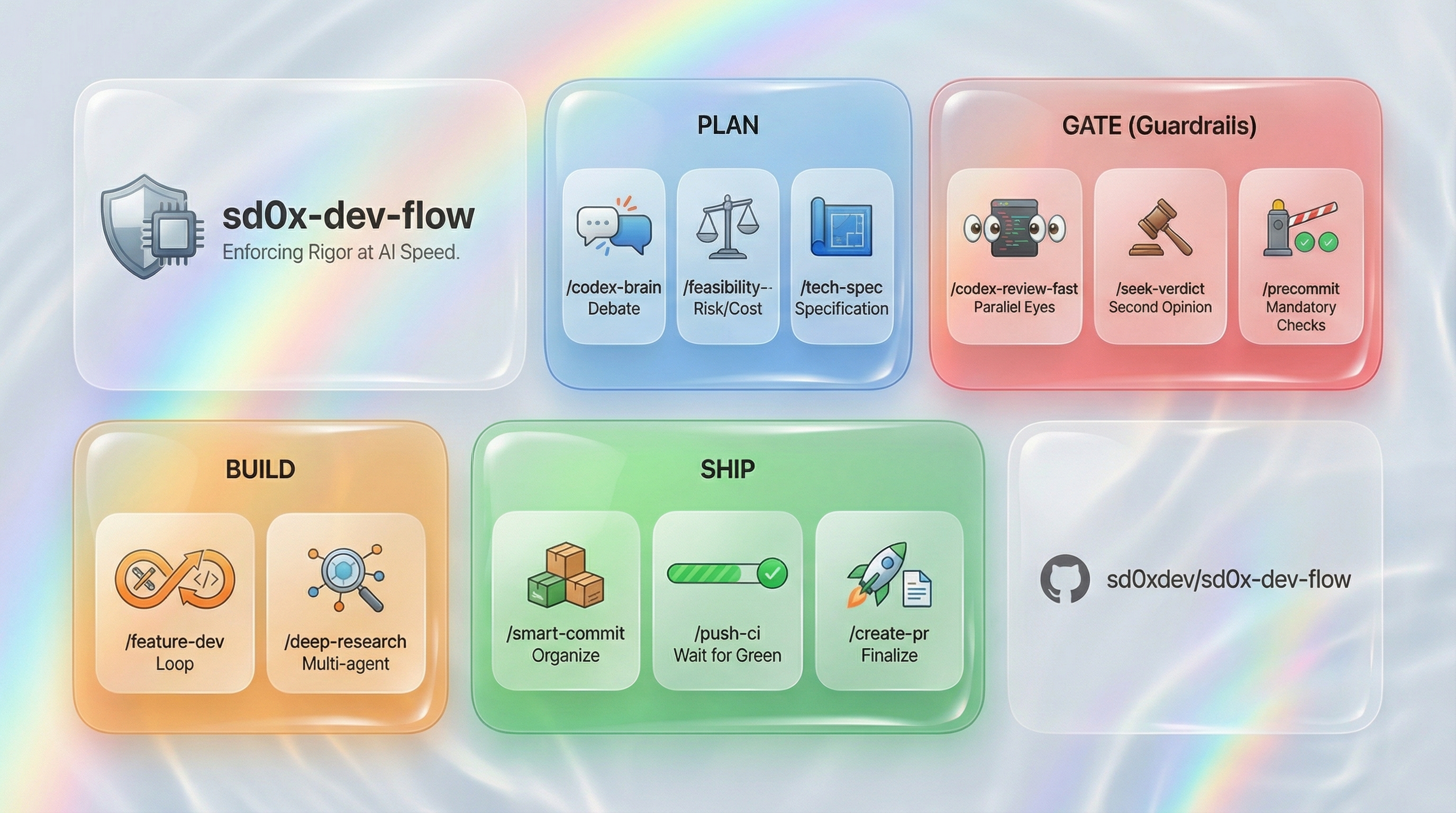
Language: English | 繁體中文 | 简体中文 | 日本語 | 한국어 | Español
The harness layer for Claude Code.
Quality gates that AI can't skip. A reference implementation of AI Agent Harness Engineering for Claude Code — hook-enforced dual review, state-machine gates that survive context compaction, and fail-closed safety where it counts.
96 bundled · 96 public skills · 15 agents — ~4% of Claude's context window

Harness engineering is the discipline of engineering everything around the LLM — tool loops, context management, hooks, state machines, safety layers — as opposed to training the model itself. Mitchell Hashimoto coined the term in Feb 2026; Anthropic engineering and Martin Fowler have published on it; arXiv 2603.05344 formalizes it.
sd0x-dev-flow is a reference implementation. Each row below maps a canonical harness sub-problem to concrete code you can study:
| # | Harness sub-problem | sd0x-dev-flow implementation | Code evidence |
|---|---|---|---|
| 1 | Tool loop control | /codex-review-fast → /precommit auto-loop with sentinel-driven transitions | rules/auto-loop.md + hooks/post-tool-review-state.sh |
| 2 | Sentinel-driven state machine | ✅ Ready / ⛔ Blocked / ✅ All Pass gate markers parsed into durable state | scripts/emit-review-gate.sh (producer) + hooks/post-tool-review-state.sh (parser) |
| 3 | Context recovery across compaction | [AUTO_LOOP_RESUME] stdout injection after SessionStart(compact) | hooks/post-compact-auto-loop.sh |
| 4 | Lifecycle interceptors | 5 hook event types dispatched to 8 scripts: PreToolUse / PostToolUse / Stop / SessionStart / UserPromptSubmit | hooks/ (8 scripts) + .claude/settings.json |
| 5 | Capability-based tool gating | Skill frontmatter allowed-tools — e.g., /ask has no Edit/Write | 86 of 95 public skills declare allowed-tools |
| 6 | Defense-in-depth safety | 5 layers: pre-edit-guard → commit-msg-guard → pre-push-gate → stop-guard → sidecar fail-closed marker | scripts/pre-push-gate.sh + scripts/commit-msg-guard.sh + hooks/stop-guard.sh |
| 7 | Generator-evaluator split | Dual review: Codex (primary) + Claude (secondary) dispatched in parallel on every review cycle | rules/codex-invocation.md + rules/auto-loop.md (Dual Review Mode) |
| 8 | Incremental progress tracking | iteration_history.current_round + max_rounds + convergence plateau detection | rules/auto-loop.md (exit conditions + strategic reset) |
| 9 | Human-in-the-loop safety gates | /dev/tty confirmation + AskUserQuestion for destructive ops | scripts/pre-push-gate.sh + skills/push-ci/SKILL.md |
| 10 | Self-improvement loop | Correction → record lesson → promote to rule after 3+ recurrences | rules/self-improvement.md |
Most harness projects cover 2–4 of these. sd0x-dev-flow covers all 10 — which makes the code useful as a study target, not just a tool.
| Without guardrails | With sd0x-dev-flow |
|---|---|
| AI skips review when context is long | Hook-enforced: stop-guard blocks incomplete reviews |
| Single reviewer misses issues | Dual dispatch: Codex + secondary in parallel |
| "Fixed it" without re-verification | Auto-loop: fix → re-review → pass → continue |
| Review state lost after compact | State tracking: SessionStart hook re-injects |
# Install plugin
/plugin marketplace add sd0xdev/sd0x-dev-flow
/plugin install sd0x-dev-flow@sd0xdev-marketplace

# Configure your project
/project-setup
One command auto-detects framework, package manager, database, entrypoints, and scripts. Installs a subset of rules and hooks; the full plugin bundles 14 rules + 9 hooks.
npx claudepluginhub sd0xdev/sd0x-dev-flow --plugin sd0x-dev-flowCorca Workflow Framework — consolidated hooks and skill orchestration for structured development sessions
 corca-ai
AI-powered development workflow automation - Phase-based planning, implementation orchestration, preflight code quality checks with security scanning, ship-it workflow, and development principles generator for CLAUDE.md
 charlesjones-dev
Persona-driven AI development team: orchestrator, team agents, review agents, skills, slash commands, and advisory hooks for Claude Code
 bdfinst
Verification-first engineering toolkit for Claude Code. 15 skills across a 5-phase spine (Investigate → Design → Implement → Verify → Ship), 8 specialist agents, an interactive setup wizard. Every skill has rationalizations + evidence requirements. Built for senior ICs and tech leads.
 duthaho
HarnessFlow — From idea to shipped product: high-quality engineering workflows for AI agents. Spec-anchored SDD, gated TDD, evidence-based routing, independent reviews, and formal closeout.
 hujianbest
Unified Claude Code plugin merging superpowers workflows (TDD, debugging, planning) with everything-claude-code productivity (agents, learning, hooks, rules)
 BinyaminEden