Stats
Actions
Available In
Tags

Take an idea from fuzzy to shipped product using an autonomous pipeline that ideates, validates, decomposes into self-contained prompts, and iterates via build-loop with self-verification and accessibility audits.
Run the idea-to-ship pipeline AUTONOMOUSLY, in character as a grounded founder-persona — composing ideate → deep-dive → prompt-pack → build-loop to take a real, grounded niche to a near-finish-line-AIMED first-draft product plus an honest ledger of what only a human or the market can finish. ALWAYS invoke when the user says any of "run autopilot", "build this idea→ship autonomously", "spin up a grounded founder and build it", "fly the whole pipeline end to end", or "autonomous first-draft from a concept". It composes the existing skills, never reimplementing them, and states its honest bounds — a near-finish-line first draft, NOT a finished or market-validated product (~80% craft ceiling; grounding firewall; its go/kill calls are a signal). Do NOT use to drive each phase by hand (use the skills directly), when there's no real grounding (you'd be inventing demand), or when you need market validation (the human handoff).
Drive a build to actually-works, near-finish-line craft by looping build → see → exercise → check → critique → rebuild over the agent's existing tools (bash build/test, headless screenshot + vision, Playwright, axe/Lighthouse) until acceptance criteria pass or an explicit stop-condition fires — no infinite thrash. ALWAYS invoke when the user says any of "tighten this build", "iterate until it passes", "self-verify the UI", "make it actually work, not just compile", "loop until the core flows pass", or "drive this to near-finish-line". Also invoke proactively after a scaffold or feature lands and before handing a draft to a human. Composition-first over existing tools, not a new program; it states its own honest bounds — objective craft only, taste self-graded, ~80% ceiling, market validation out of scope. Do NOT use to decide WHAT to build (that's ideate) or whether a design/strategy is sound (deep-dive).
Rigorous multi-agent deep-dive analysis for complex investigative tasks — auditing codebases, evaluating strategies or systems, validating designs, doing open-ended research. Deploys 4–6 specialist agents in parallel across distinct lanes, then synthesis, then adversarial red-team review, then optional patching — producing structured markdown research files plus a plain-English executive briefing with honest 1–10 confidence ratings. ALWAYS invoke when the user says any of "deep dive", "thorough audit", "rigorous analysis", "comprehensive review", "audit this codebase", "analyze the strategy", "evaluate this design", "review this thoroughly", or "research deep dive". Also invoke proactively for any open-ended investigative task involving a codebase, strategy, system design, or research question that warrants 30+ minutes of structured analysis — even when the user doesn't use these exact phrases.
Take a fuzzy idea (or an existing thing you want to improve) through a disciplined funnel — explore → pressure-test → converge — and produce one living CONCEPT_BRIEF.md: a locked concept + phased roadmap. Acts as a blunt, honest co-founder (permission to overrule you), forces a success metric and a kill criterion before any roadmap, and hands off cleanly to the prompt-pack skill for building. ALWAYS invoke when the user says any of "help me figure out what to build", "I have an idea for…", "is this idea any good", "pressure-test this idea", "should I build / should I rebuild X", "evaluate whether my app/idea is worth building", "where are we really at", "is this idea or app worth pursuing", "iron out / scope / spec this concept", or "turn my idea into a plan/roadmap". Also invoke proactively when someone is reasoning about WHAT to build or WHETHER an idea is worth it — before any code or prompt pack exists.
Author and execute "prompt packs" — a big job broken into a sequence of self-contained, independently-shippable prompts, each run in its own fresh chat so a single change never dies to a context/token limit. Also writes paste-ready handoff briefings to resume a dying chat or relay work to another tool (e.g. Codex). ALWAYS invoke when the user says any of "make a prompt pack", "turn this into prompts", "break this into phases", "prompts I can run in separate chats", "I'm running out of tokens/context", "write me a handoff", "a prompt I can paste into a new chat", "this is too big for one chat", "build plan I can hand off", or "execute Pxx / phase X from the pack". Also invoke proactively when a requested change is too large or too risky to finish safely in one session and should be decomposed into ordered, verifiable steps.
Own this plugin?
Verify ownership to unlock analytics, metadata editing, and a verified badge. GitHub access is read-only (username + org membership).
Sign in to claimOwn this plugin?
Verify ownership to unlock analytics, metadata editing, and a verified badge. GitHub access is read-only (username + org membership).
Sign in to claimBased on adoption, maintenance, documentation, and repository signals. Not a security audit or endorsement.
Composable Agent Skills — for Claude and OpenAI Codex — that take an idea from fuzzy → validated → sequenced build → shipped: by hand, or on autopilot.
Most "build with AI" workflows skip the hard half. They jump straight to code — and skip deciding what's actually worth building, validating it honestly, and planning the build so it ships in safe, verifiable steps. idea-to-ship is that missing front half — plus the autonomous build loop on the far side of it: a small, sharp suite of Agent Skills (they run in Claude and OpenAI Codex), reverse-engineered from real idea→ship journeys (including the mistakes those journeys made), so you don't repeat them.

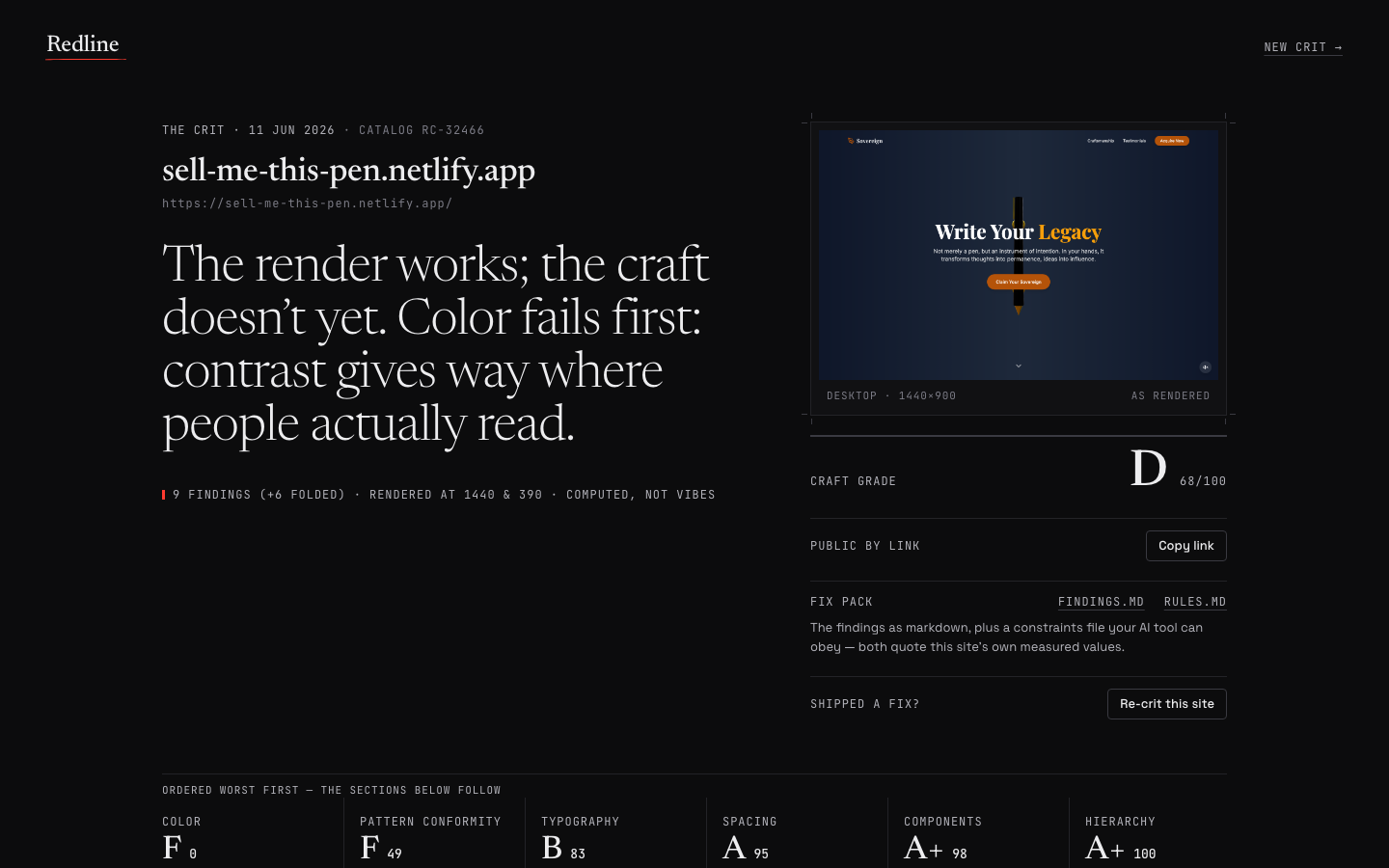
Real output: a crit page from Redline, built unattended by autopilot in one 13.5-hour overnight run. See the case study, including where it failed.
They're separate, composable skills on purpose — sharp triggers, lean context, independent use. Run them by hand (the manual tier), or let autopilot fly the whole line for you (the autonomous tier).
Who it's for. Solo and small-team builders who tend to start coding before deciding what's actually worth building — working in Claude or OpenAI Codex. If you've shipped a feature nobody used, rebuilt something and lost the parts that worked, or watched a big change stall halfway, this suite front-loads the discipline that prevents it. Each skill also earns its keep alone. (deep-dive is token-hungry by design — see its note below; it shines most when you're not token-constrained, e.g. on a Claude Max plan.)
ideate — turn a fuzzy idea (or an existing thing you want to improve) into a locked concept + roadmap, captured in one living CONCEPT_BRIEF.md. A blunt, honest co-founder: it forces a success metric and a kill criterion, refuses to spec before the concept survives an honest pressure-test, and hands off cleanly to prompt-pack.deep-dive — the rigor engine ideate leans on for high-stakes validation (and that you can run directly on any codebase, strategy, design, or research question): parallel specialist agents → synthesis → adversarial red-team → a plain-English verdict with honest 1–10 confidence.prompt-pack — turn a settled concept into a sequence of self-contained, independently-shippable build prompts: each does one unit, verifies itself, and leaves the app working before the next. Run them in one chat or spread across many — each prompt is self-contained, so any unit moves cleanly to a fresh chat whenever you want (or need) one. Also writes paste-ready handoffs to resume a chat or relay work to another tool.build-loop — drive a build past "it compiles" to near-finish-line craft: it sees and exercises the running app — render → screenshot → critique → rebuild, multi-pass — and checks the machine facts (build, tests, flows, console, a11y) until acceptance criteria pass or a stop-condition fires (no infinite thrash). When feel is load-bearing the visual design loop runs every iteration. Honest bound: objective craft + a self-graded taste pass, ~80% of the way — not a finished or validated product.→ drive each step yourself, or let autopilot fly the whole line autonomously — in character as a grounded founder-persona — handing back a near-finish-line first draft plus an honest ledger of what only a human or the market can finish.
| If you want to… | Type this | You get back |
|---|---|---|
| Decide what to build | "I have an idea for X — help me decide if it's worth building." | docs/CONCEPT_BRIEF.md |
| Investigate something rigorously | "Do a standard design evaluation of X. Research-only." | research/<topic>/ + an executive briefing |
| Turn settled scope into a build plan | "Make a prompt pack from docs/CONCEPT_BRIEF.md." (or "X is too big for one chat — make me a prompt pack.") | docs/<TOPIC>_PROMPT_PACK.md |
| Drive a build to near-finish-line craft | "Loop on this until the core flows pass and the UI holds its design bar." | a self-verified, iterated build + an honest craft ledger |
| Fly the whole pipeline autonomously | "Run autopilot on X." | a CONCEPT_BRIEF, a build pack, a first-draft app + an honest hand-off |
npx claudepluginhub nelsonwerd/idea-to-ship-skills --plugin idea-to-shipEditorial "Web Designer" bundle for Claude Code from Antigravity Awesome Skills.
 sickn33
Ultra-compressed communication mode. Cuts ~75% of tokens while keeping full technical accuracy by speaking like a caveman.
 JuliusBrussee
Frontend design skill for UI/UX implementation
 anthropics
Comprehensive UI/UX design plugin for mobile (iOS, Android, React Native) and web applications with design systems, accessibility, and modern patterns
 wshobson
Memory compression system for Claude Code - persist context across sessions
 thedotmack
Marketing skills for AI agents — conversion optimization, copywriting, SEO, paid ads, ad creative, and growth
 coreyhaines31