Stats
Actions
Available In
Tags

Audits database schemas, migrations, and performance across SQL and NoSQL engines, scoring Design & Integrity and Performance & Scale, then applies safe reversible fixes on explicit command
The ONLY agent allowed to write files. Used exclusively by the fix skill (the /claude-db:fix command) AFTER the user has confirmed the diffs. Applies AUTO/PROPOSED fixes, generates reversible timestamped migrations, backs up first, refuses a dirty git tree unless --force, is idempotent, and re-verifies each change.
Read-only migration-safety specialist. Use proactively during a database audit to analyze migration reversibility, lock level, table rewrites, destructive operations, enum mutation, and schema drift. Runs scripts/lint-migration.mjs. Feeds the Performance & Scale score.
Read-only NoSQL paradigm specialist. Use proactively during a database audit of document, key-value, or wide-column stores to analyze antipattern fit and access-pattern alignment — unbounded arrays, missing partition/sort keys, hot keys, fan-out, denormalization drift, and idempotency. Feeds both scores via the natural module's axis.
Read-only performance & scale specialist. Use proactively during a database audit to analyze indexing, index hygiene, query patterns, concurrency, connection pooling, partitioning/sharding, replicas/views, and storage/bloat. Feeds the Performance & Scale score.
Read-only schema & data-integrity specialist. Use proactively during a database audit to analyze normalization, primary-key strategy, referential integrity, types/precision, constraints, defaults/generated columns, naming, temporal/history, multitenancy, and security/access. Feeds the Design & Integrity score.
Audit a database schema, ORM model, or migrations for design and performance — produces two independent 0-100 scores (Design & Integrity + Performance & Scale) plus a prioritized, evidence-backed report. Read-only; never writes or migrates. Use when the user asks to audit, analyze, review, check, or score a database, schema, data model, migrations, indexes, keys, referential integrity, types, constraints, query patterns, partitioning, or connection pooling — for Postgres, MySQL, Mongo, DynamoDB, Cassandra, pgvector, ClickHouse, Neo4j, and friends.
Render a production-readiness GO/NO-GO grid for a database — runs a read-only audit, then maps the findings onto a fixed launch checklist (PITR/backups, RLS on tenant tables, FK indexes, money-as-numeric, timestamptz/UTC, connection pooling sized, migration reversibility, secrets-not-in-schema, charset/utf8mb4). Each row is PASS/WARN/FAIL/NEEDS-LIVE with the finding id, topped by a plain-language verdict. Read-only. Use when the user asks if a database is production-ready, ready to launch/ship, a go/no-go, a pre-launch or readiness checklist, or what to fix before going live.
Unified cross-paradigm anti-pattern catalog (M19) — relational and NoSQL smells that no single structural module owns cleanly: EAV / generic key-value tables, the "god table" with hundreds of columns, comma-separated lists in a column, polymorphic associations without FK, boolean-flag soup, Mongo unbounded array growth, deeply nested documents, the document fan-out / "join in app code" trap, Redis as a relied-on durable primary store. Each finding is re-homed to inherit the natural module's category. Feeds the Design & Integrity AND Performance & Scale scores depending on the smell.
Audit concurrency correctness — transaction isolation level, lost-update / read-modify-write races, queue-worker contention (SKIP LOCKED), and idempotency for key-value / document / wide-column writes. Module M14. Feeds the Performance & Scale score.
Audit connection management — serverless functions opening direct Postgres connections, transaction-mode pooler misuse (PgBouncer / Supabase / prepared statements), and pool sizing against backend max_connections. Module M15. Feeds the Performance & Scale score.
Executes bash commands
Hook triggers when Bash tool is used
Modifies files
Hook triggers on file write and edit operations
Own this plugin?
Verify ownership to unlock analytics, metadata editing, and a verified badge. GitHub access is read-only (username + org membership).
Sign in to claimOwn this plugin?
Verify ownership to unlock analytics, metadata editing, and a verified badge. GitHub access is read-only (username + org membership).
Sign in to claimBased on adoption, maintenance, documentation, and repository signals. Not a security audit or endorsement.
Uses power tools
Uses Bash, Write, or Edit tools
Uses power tools
Uses Bash, Write, or Edit tools
The multi-paradigm database expert for Claude Code.
Design a new schema, audit an existing one on two independent axes — Design & Integrity and Performance & Scale — and optionally plan the safe migration for you.




-2ea44f.svg)
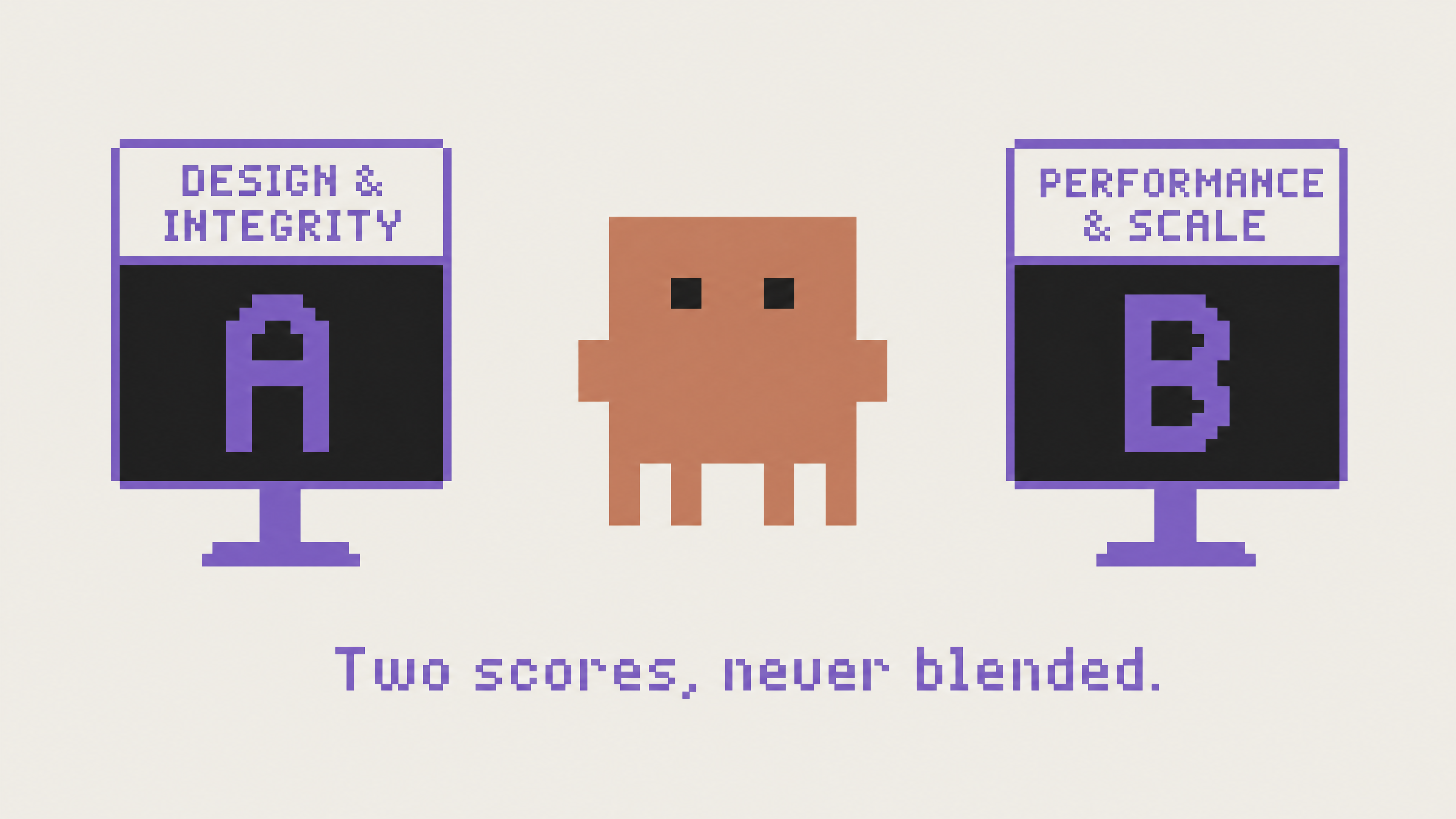
Two scores, never blended. A schema can be impeccably modeled yet collapse under load, or scream fast yet silently corrupt your data.
claude-dbmeasures Design & Integrity and Performance & Scale separately and tells you exactly what to fix on each.
🇪🇸 Resumen en español al final · README completo en README.es.md · guías en docs/es/.
Most database tooling does one thing: a linter checks style, an EXPLAIN tab shows one query, an ORM hides the schema entirely. None of them sit a senior DBA next to you who can read your schema.prisma or live catalog, reason across modeling, integrity, indexing, concurrency, and migration safety at once, and weigh the trade-offs for your paradigm — relational, document, key-value, wide-column, vector, time-series, or graph.
claude-db is that reviewer. It is honest by construction: every finding ships with observed evidence and a runnable verification command, magnitudes are banded (high/medium/low), and it never fabricates a latency number, a row count, or a price. When a check genuinely needs a live database, it says needs_api — never a silent pass.
Original work, MIT-licensed — inspired by the patterns of community database tooling but copying no branding, text, or names from any other project.
As a Claude Code plugin (recommended):
/plugin marketplace add Hainrixz/claude-db
/plugin install claude-db@claude-db
/reload-plugins
Cross-agent (Cursor, Codex, Gemini CLI, Windsurf…) via Vercel Skills:
npx skills add Hainrixz/claude-db
The plugin works fully offline (Tier 0, no keys) against your schema/migration/ORM files or a plain-language description. See Data tiers for opt-in live introspection.
/claude-db:start                                           # ← start here: a no-jargon wizard (no files needed)
/claude-db:design   "<what you're building>" [--scale small|medium|large]   # recommend an engine + draft a schema + diagram
/claude-db:audit    "<path|$DATABASE_URL>" [--paradigm auto|…] [--tier 0|1|2]  # two scores + prioritized findings (read-only)
/claude-db:explain  "<path|table|finding-id>" [--query "<SQL>"]             # plain-language explainer / why-is-this-slow
/claude-db:migrate  "<migration-file>"  |  "<from-schema>" "<to-schema>"     # lint a migration, or diff two schemas → migration
/claude-db:fix      "<path>" [--category keys|indexing|constraints|migration|…] [--dry-run]   # opt-in, per-change confirm
/claude-db:next     "[findings.json]"                      # coach: the single highest-leverage fix, ranked
/claude-db:score    "[findings.json]" [--paradigm …]       # recompute the two scores
/claude-db:seed     "<path>" [--rows N]                    # generate FK-aware sample/seed data for a schema
/claude-db:checklist "<path|$DATABASE_URL>"                # production-readiness go/no-go grid
audit, explain, score, next, and checklist are read-only and never touch your files or write to your database. fix previews diffs by default and writes only after you confirm each change; destructive migrations require typing the object name back. First time? Run /claude-db:start — it asks 7 plain questions and recommends what to build. Power users can call any module directly, e.g. /claude-db:db-indexing.
npx claudepluginhub hainrixz/claude-db --plugin claude-dbOpen-source cybersecurity analysis agent. Scans any local project for vulnerabilities: code security (SAST), dependency CVEs (SCA), secret leaks, authentication/authorization flaws, cryptographic weaknesses, misconfigurations, supply chain risks, and CI/CD security. Covers all OWASP 2025 Top 10 and CWE Top 25 categories. Generates prioritized reports with remediation guidance. Invoke with /cyber-neo [path].
 Hainrixz
Tododeia — Multi-agent investment analysis system for market research, portfolio recommendations, and interactive reporting across crypto, stocks, forex, and commodities.
HainrixzFree-first paid advertising audit and AI creative generation for Claude Code, focused on the 3 platforms where 95% of advertiser spend lives: Meta, Google, TikTok. Includes a guided first-run wizard (/ads start) with step-by-step OAuth verification and a continuous coach (/ads next) that ranks Quick Wins after every audit. ~158 weighted audit checks, parallel agents, industry templates, PPC math, A/B test design, PDF reports, /ads update for refreshing platform references, and /ads publish to 14+ social networks via Zernio (free for 2 accounts).
HainrixzES: Vuelve a Claude en tu contra para criticar a fondo una idea, un plan o un proyecto entero — sin validar ni suavizar — por ocho ángulos, con investigación de fracasos reales y un veredicto priorizado de qué arreglar. EN: Turn Claude against you to harshly critique an idea, plan, or whole project across eight angles with a prioritized verdict.
HainrixzEN: Reflect on the current conversation and save reusable learnings (memories, anti-patterns / Reflexion-style lessons, skill stubs, project-doc updates) with explicit confirmation. ES: Reflexiona sobre la conversación actual y guarda aprendizajes reusables (memorias, anti-patrones estilo Reflexion, stubs de skills, actualizaciones de project-docs) con confirmación explícita.
HainrixzComplete creative writing suite with 10 specialized agents covering the full writing process: research gathering, character development, story architecture, world-building, dialogue coaching, editing/review, outlining, content strategy, believability auditing, and prose style/voice analysis. Includes genre-specific guides, templates, and quality checklists.
 greyhaven-ai
Comprehensive skill pack with 66 specialized skills for full-stack developers: 12 language experts (Python, TypeScript, Go, Rust, C++, Swift, Kotlin, C#, PHP, Java, SQL, JavaScript), 10 backend frameworks, 6 frontend/mobile, plus infrastructure, DevOps, security, and testing. Features progressive disclosure architecture for 50% faster loading.
 Jeffallan
A growing collection of Claude-compatible academic workflow bundles. Covers scientific figures, manuscript writing and polishing, reviewer assessment, citation retrieval, data availability, paper reading, literature search, response letters, paper-to-PPTX conversion, and evidence-grounded Chinese invention patent drafting. Rules are organized as reusable skill folders with explicit workflows and quality checks.
 Yuan1z0825
Upstash Context7 MCP server for up-to-date documentation lookup. Pull version-specific documentation and code examples directly from source repositories into your LLM context.
 upstash
Intelligent draw.io diagramming plugin with AI-powered diagram generation, multi-platform embedding (GitHub, Confluence, Azure DevOps, Notion, Teams, Harness), conditional formatting, live data binding, and MCP server integration for programmatic diagram creation and management.
 markus41
Comprehensive startup business analysis with market sizing (TAM/SAM/SOM), financial modeling, team planning, and strategic research
 wshobson