Stats
Actions
Available In
Tags

Hub meta-engineering toolkit — 29 skills + 7 agents. New in 1.3.0: public-surface-audit (git-tracked private-token leak scan), field-harvest Mode B session-end auto-trigger, 4-axis gate scope extension (docs/ + AGENTS.md). New in 1.2.0: pipeline-conductor (4-pipeline gated sweep), return-path-gate (chain closure audit), goal-quench (Stop hook + quality gate), steel-quench Wave 5 (multi-model sidecar challenger), 2-layer architecture docs, YAML validation script. Validated cross-CLI: Claude Code, Codex, Gemini.
Based on adoption, maintenance, documentation, and repository signals. Not a security audit or endorsement.
Frontier-grade first-contact standpoint evaluator. Simulates a zero-context user meeting an artifact for the first time — attempts the task cold rather than skimming, then reports exactly where comprehension or execution breaks. Lowest tier of the user-mastery spectrum (beginner → main-player → expert). Constructive standpoint, not an adversary — surfaces onboarding friction a fluent author cannot feel. Returns parallax-compatible [Strengths / Concerns / Absence check / Open questions]. Use when you need a true cold-read of a SKILL, README, prompt, or onboarding path.
Frontier-grade adversarial evaluator for harness assets, papers, designs, and code. Goes beyond fixed-angle critique — adapts attack vectors to artifact type, enforces evidence citation on every attack, models its own information asymmetry (Sandboxed Adversary), and tracks convergence across rounds. Returns structured [issue · location · severity] output consumable by steel-quench, harvest-loop, and sim-conductor. Use when you need adversarial pressure that a self-reviewing author cannot generate.
Frontier-grade domain-authority evaluator. Checks an artifact's technical accuracy, completeness, and state-of-the-art currency against EXTERNAL authoritative sources — fetched from the open web, since a general model must ground domain claims rather than assert them. Top tier of the user-mastery spectrum (beginner → main-player → expert): the professor / prolific author / frontier-harness operator. Every accuracy judgment carries an external citation; ungrounded assertions are withheld. Returns parallax-compatible output. Use when "is this technically correct and current with the field?" matters.
Use when (1) about to recommend an asset, skill, or agent that may already exist in the hub, (2) memory or docs contain stale facts, dates, or references, or (3) duplicate work is suspected. Greps hub assets and reports findings. Not for general code review or external persona audits.
Use when an external-facing draft (briefing, card, guide) is ready for pre-publication audit. Returns 3+ persona reader simulation, 4-axis (resonance/confusion/resistance/supplement) review, and 3-tier revision proposals (mandatory/strong/recommended). Do not use for internal memos, CATALOG entries, memory files, code review, or PR review.
Given a task description, searches internal and external open-source ecosystems (including Codex marketplace and Claude Code marketplace) to find and recommend suitable plugins with installation guidance. Recommendation is quality-validation based (marketplace-listed + performance-validated), not source-origin based. Activates on "recommend a plugin", "what tool should I use?", "is there a plugin for this?", "recommend a tool". Also checks for duplicate installations.
Detects harness regressions by running standard prompt probes after rule/skill changes and comparing outputs against saved baselines. Triggers on "prompt regression", "did my changes break anything", "regression check", "test harness changes".
Scans git-tracked (public) files for operator-private tokens that should live only in gitignored files — real usernames, absolute home paths, companion-store names, company asset names. Reports file:line + matched token + severity, so a public/private split stays clean before publish. Triggered by "public surface audit", "did I leak anything", "check tracked files for private tokens", "private token scan", "public-surface-audit".
Audits SKILL.md files in plugins/ for return-path gate compliance. Detects fire-and-forget chains where a caller dispatches a downstream skill but does not gate its next step on the callee's verdict. Reports each chain as CLOSED or OPEN and outputs specific fix suggestions. Triggered by "chain audit", "return-path check", "fire-and-forget detection", "chain closure audit", "skill chain compliance".
DEPRECATED — merged into harness-doctor --lint mode (2026-06-02). Language pattern detection (self-marketing, cushion words, version labels) is now Step 3-L of harness-doctor. Use /harness-doctor --lint instead.
Uses power tools
Uses Bash, Write, or Edit tools
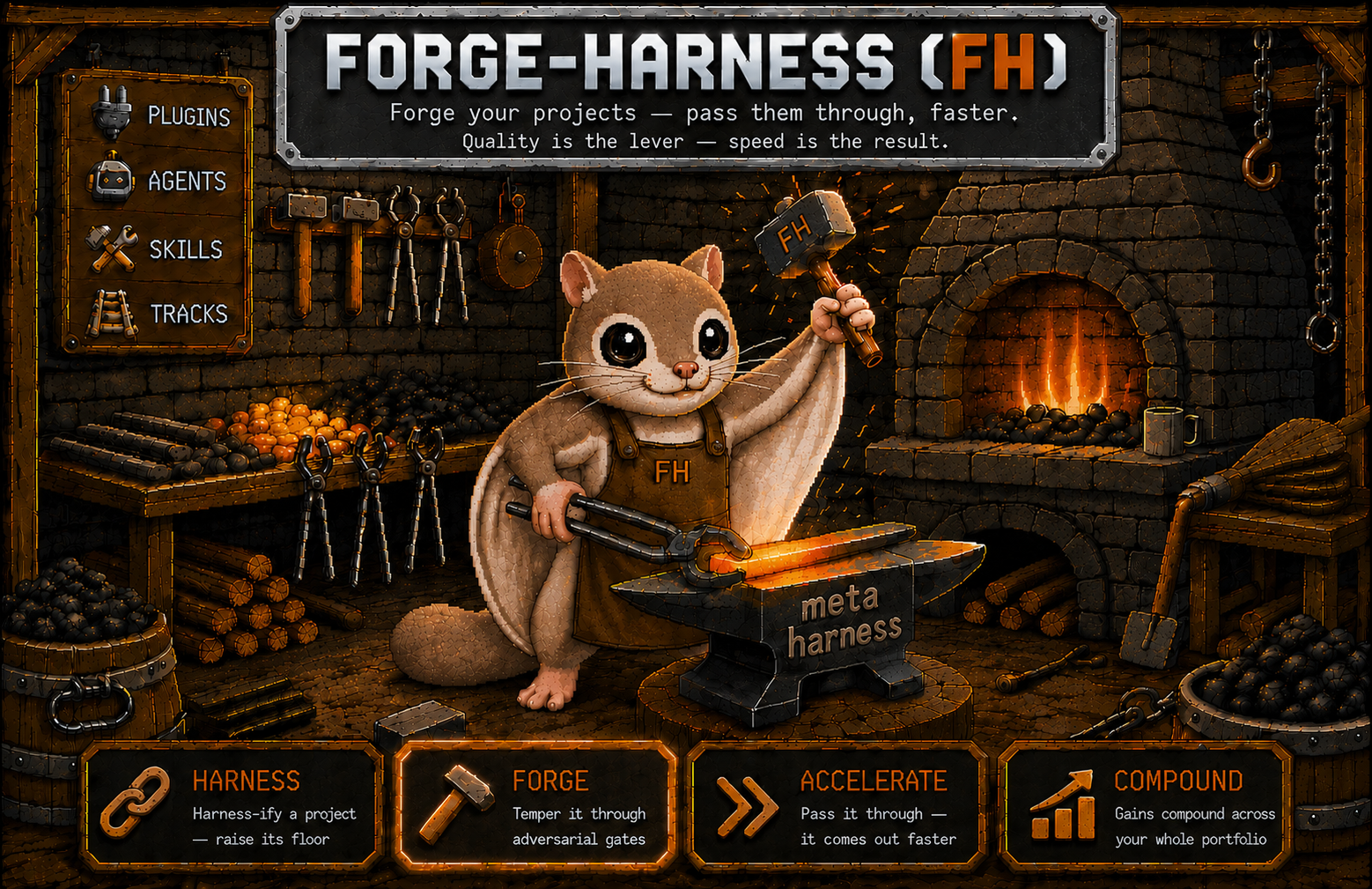





Forge your Claude Code projects — pass them through, they come out faster.
A practitioner's meta-harness: it raises each project's floor (harness-ify the setup)
and ceiling (accelerate the work), then compounds the gains across your whole portfolio.
Quality is the lever; speed is the result. Every change earns its way through the gates —
adversarial · phantom · regression — and that is what makes the next change faster.
Fork it. Rename it. Make it yours.

The principles · Why it exists · The evidence · How to use it
| If you're here because… | forge-harness solves it |
|---|---|
| Context disappears when a session ends | Persistent tracks/ — resumable from anywhere |
| You repeat the same setup across projects | Connect once to the hub, share across all projects |
| Team AI know-how lives only in people's heads | Codify it so everyone shares it |
| You want AI to get better as work accumulates | Skills and patterns compound session over session |
| You need a governance layer for AI-generated code | fh-gate wraps any coding agent as a post-generation gate |
This document is for humans. AI operating rules →
CLAUDE.md· Command reference →CHEATSHEET.md
Prerequisite: Claude Code CLI — verify with claude --version
# 1. Install the plugin
claude plugin marketplace add https://github.com/chrono-meta/forge-harness.git
claude plugin install -s user fh-meta@forge-harness

# 2. Clone the hub
git clone https://github.com/chrono-meta/forge-harness.git ~/forge-harness
cd ~/forge-harness

# 3. Start a session
claude
✅ Claude reads
CLAUDE.mdand asks what project to connect or what task to start. Say "Connect a project" → hub scans../, finds.gitdirectories, createstracks/{project}/.
Plugin only (no clone):
claude plugin marketplace add https://github.com/chrono-meta/forge-harness.git  # once
claude plugin install -s user fh-meta@forge-harness
cd ~/projects/{your-project} && claude
⚠️ Plugin-only is partial synergy. You get the skills and agents, but not Layer 1 — the
CLAUDE.mdgovernance (active onboarding, the 4-axis gate, mode branching) and the compounding context (tracks/memory accumulation,harvest-looplearning). Each skill runs the same in isolation; what's missing is the orchestration that makes them compound across sessions. Clone the hub (above) when you want the full set, not just the tools.
🚪 New here / just want the skills? Start with the opinionated front door —
templates/starter_profile.md: one install command, a curated first-five skills, and a zero-install governance gate (npx … fh-gate). The other 28 skills wait until you need them.
forge-harness is structured as two distinct layers:
| Layer | Contents | AI compatibility |
|---|---|---|
| Methodology layer | tracks/, knowledge/, SKILL.md docs, session protocols | Any AI model |
| Automation layer | .claude/agents/, hooks, slash commands, CLAUDE.md rules | Claude Code only |
The methodology layer is the portable core — persistent hub, accumulating learnings, curating cross-project knowledge. The automation layer makes it frictionless when running Claude Code.
Own this plugin?
Verify ownership to unlock analytics, metadata editing, and a verified badge. GitHub access is read-only (username + org membership).
Sign in to claimOwn this plugin?
Verify ownership to unlock analytics, metadata editing, and a verified badge. GitHub access is read-only (username + org membership).
Sign in to claimnpx claudepluginhub chrono-meta/forge-harness --plugin fh-metaCross-project utility skill bundle — 4 skills + 1 agent. Domain-agnostic and portable: convergence-loop, deliberation, mcp-circuit-breaker, token-budget-gate + quench-challenger agent.
chrono-metaComprehensive feature development workflow with specialized agents for codebase exploration, architecture design, and quality review
 anthropics
A growing collection of Claude-compatible academic workflow bundles. Covers scientific figures, manuscript writing and polishing, reviewer assessment, citation retrieval, data availability, paper reading, literature search, response letters, paper-to-PPTX conversion, and evidence-grounded Chinese invention patent drafting. Rules are organized as reusable skill folders with explicit workflows and quality checks.
 Yuan1z0825
Upstash Context7 MCP server for up-to-date documentation lookup. Pull version-specific documentation and code examples directly from source repositories into your LLM context.
 upstash
Comprehensive skill pack with 66 specialized skills for full-stack developers: 12 language experts (Python, TypeScript, Go, Rust, C++, Swift, Kotlin, C#, PHP, Java, SQL, JavaScript), 10 backend frameworks, 6 frontend/mobile, plus infrastructure, DevOps, security, and testing. Features progressive disclosure architecture for 50% faster loading.
 Jeffallan
Tools to maintain and improve CLAUDE.md files - audit quality, capture session learnings, and keep project memory current.
anthropicsDevelop, test, build, and deploy Godot 4.x games with Claude Code. Includes GdUnit4 testing, web/desktop exports, CI/CD pipelines, and deployment to Vercel/GitHub Pages/itch.io.
 Randroids-Dojo