Stats
Links
Categories
npx claudepluginhub usathyan/epistractCross-domain knowledge graph framework. Extract structured knowledge from any document corpus. Pre-built domains: drug discovery (biomedical literature), contract analysis (vendor contracts), clinical trials (ClinicalTrials.gov v2 + PubChem enrichment via --enrich), and FDA product labels (Structured Product Labeling, four-level FDA epistemology classifier). Workbench includes runtime LLM model selector with live OpenRouter browsing, interactive node pinning, and graph visual legibility. Plus interactive workbench, domain creation wizard, automatic analyst narrator, and conversational Q&A.
 usathyan
Turn scientific literature into structured biomedical knowledge.
Paper: Beyond RAG: Domain-Specific Agentic Architecture for Biomedical Knowledge Graph Construction — technical report describing the architecture, evaluation across 6 drug discovery domains, and the evolution from GraphRAG to comprehension-based extraction.
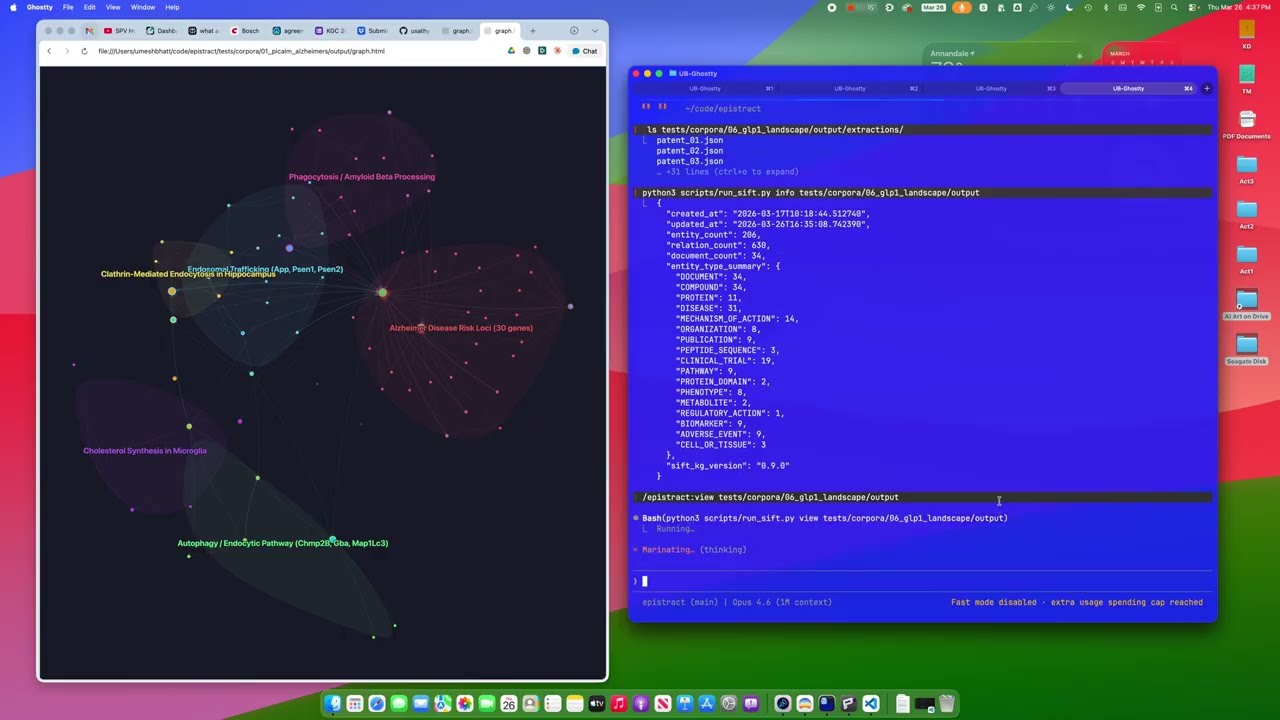
Epistract reads drug discovery documents — PubMed papers, bioRxiv preprints, patent filings, clinical trial reports, FDA labels — and builds a knowledge graph that captures the entities and relationships a scientist cares about: compounds, targets, mechanisms, trials, biomarkers, pathways, and how they connect.
It runs as a Claude Code plugin. You point it at a folder of documents. It reads them with a scientist's understanding, extracts structured knowledge using a schema grounded in 40+ established biomedical ontologies, validates molecular identifiers with RDKit and Biopython, and produces an interactive graph you can explore in your browser.
From Greek episteme (ἐπιστήμη) — structured scientific knowledge, the highest form of knowledge in Aristotle's epistemological hierarchy — combined with extract. Episteme is not opinion or belief; it is knowledge grounded in evidence, demonstration, and systematic understanding. That is what this tool produces: not a bag of keywords, but a structured representation of how scientific concepts relate to each other, traceable back to the source text.
Requires Claude Code and Python 3.11+.
Install from GitHub — run these inside any Claude Code session:
/plugin marketplace add usathyan/epistract
/plugin install epistract@epistract
Then restart Claude Code. The plugin is now available in all sessions.
For developers — clone locally and install as a dev marketplace:
git clone https://github.com/usathyan/epistract.git
/plugin marketplace add /path/to/epistract
/plugin install epistract@epistract
Restart Claude Code after installing.
Verify installation:
/epistract-setup
This installs sift-kg (the knowledge graph engine) and checks for optional molecular validation libraries (RDKit, Biopython).
Set up API keys — sift-kg uses LiteLLM for entity resolution during graph building. Set one of the following in your environment before running the pipeline:
# Option A: OpenRouter (recommended — one key, many models; used in development)
export OPENROUTER_API_KEY="your-key-here"

# Option B: OpenAI (SIFT_ prefix required — sift-kg forwards to LiteLLM)
export SIFT_OPENAI_API_KEY="your-key-here"

# Option C: Anthropic (SIFT_ prefix required)
export SIFT_ANTHROPIC_API_KEY="your-key-here"

# Option D: Google Gemini (SIFT_ prefix required)
export SIFT_GEMINI_API_KEY="your-key-here"

# Option E: AWS Bedrock (standard AWS credentials — LiteLLM reads directly)
export AWS_ACCESS_KEY_ID="your-key"
export AWS_SECRET_ACCESS_KEY="your-secret"
export AWS_REGION_NAME="us-east-1"

# Option F: Local models via Ollama (no API key needed)
# Just ensure ollama is running: ollama serve
Note: OpenRouter and AWS Bedrock keys are read directly by LiteLLM (no prefix). OpenAI, Anthropic, and Gemini keys use the
SIFT_prefix because sift-kg manages them through its config layer. You can also setSIFT_DEFAULT_MODELto choose the model (e.g.,openai/gpt-4o-mini,anthropic/claude-haiku,ollama/llama3.3).
This is separate from Claude Code's own API access, which is handled by your Claude Code subscription.
PubMed API key (optional) — if you plan to use /epistract-acquire to search and download articles from PubMed, an NCBI API key increases rate limits from 3 to 10 requests/second. The key is free.
To obtain one:
export NCBI_API_KEY="your-key-here"
Note: The PubMed connector works without this key — it just runs at lower rate limits. For small corpora (<20 articles) you likely won't notice the difference. For larger acquisitions, the key prevents rate-limit pauses.
/epistract-ingest ./my-papers/
Claude Code marketplace entries for the plugin-safe Antigravity Awesome Skills library and its compatible editorial bundles.
Production-ready workflow orchestration with 84 marketplace plugins, 192 local specialized agents, and 156 local skills - optimized for granular installation and minimal token usage
Directory of popular Claude Code extensions including development tools, productivity plugins, and MCP integrations