Stats
Links
Categories
Forge autonomous development pipeline
npx claudepluginhub allan-mobley-jr/forgeAutonomous Next.js development pipeline with craftsman agents (Smelter, Blacksmith, Temperer, Honer)
 allan-mobley-jr
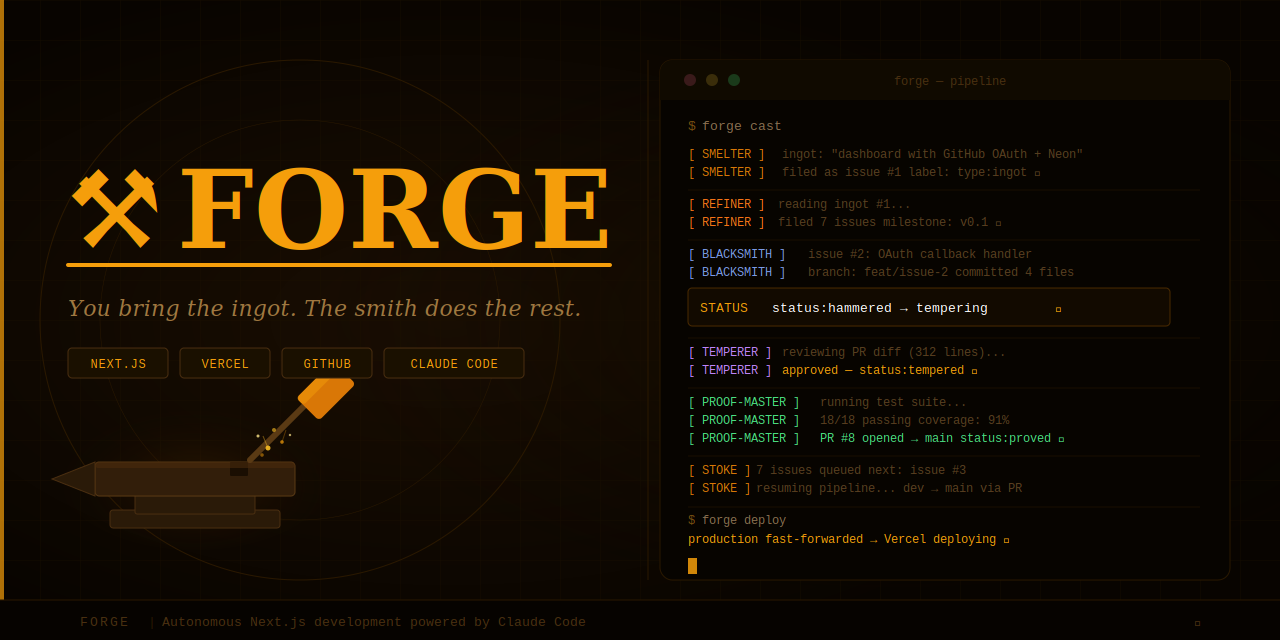
$${\color{#d97706}\textbf{Autonomous\ Next.js\ development\ powered\ by\ Claude\ Code.}}$$
$${\color{#d97706}\textbf{Describe\ your\ app\ in\ plain\ English\ —\ Forge\ plans,\ builds,\ and\ deploys\ it\ through\ GitHub\ and\ Vercel.}}$$
# Install Forge (one-time)
curl -fsSL https://raw.githubusercontent.com/allan-mobley-jr/forge/main/install.sh | bash

# Start a new project
mkdir my-app && cd my-app
forge init
Note: The installer also sets up the Vercel plugin for Claude Code and agent-browser for browser automation. The Vercel plugin requires OAuth authentication — it will prompt on first use. agent-browser runs locally and needs no auth.
Then start building:
forge smelt                  # describe your app — the Smelter plans and creates issues
forge stoke                  # autonomously implement, review, and merge each issue
forge cast                   # full autonomous cycle: smelt → stoke → hone
Forge uses a medieval forge metaphor. Three core craftsmen — each a Claude Code agent — handle the development pipeline. One post-cycle craftsman handles auditing. You invoke them one at a time, or let them run autonomously.
   ┌───────────────┐       ┌──────────┐
   │  forge init   │──────▶│  GitHub  │
   │  (bootstrap)  │       │   repo   │
   └───────────────┘       └──────────┘

   Core:        forge smelt  →  forge hammer  ⇄  forge temper  (per issue)
                                ↑─── forge stoke ───↑

   Post-cycle:  forge hone

                forge cast  =  smelt → stoke → hone (full cycle)
| Craftsman | Command | What it does |
|---|---|---|
| Smelter | forge smelt | Researches, plans, and creates sequenced implementation issues. On first run, scaffolds the project and produces INGOT.md. |
| Blacksmith | forge hammer | Implements the lowest open issue on a feature branch. Reads INGOT.md for architectural context. |
| Temperer | forge temper | Evaluates the Blacksmith's work against acceptance criteria and quality bar. Approves and merges, or sends back for rework. Manages releases. |
| Honer | forge hone | Triages bugs or audits the codebase. Files implementation issues for the Blacksmith. |
Each command has an auto- variant for autonomous operation (e.g., forge auto-smelt). In auto mode, the agent runs headless via -p without human interaction.
Every agent exists in two variants:
forge smelt): launches a Claude Code session where you confer with the agent — describe what you want, answer questions, approve the plan before it acts.forge auto-smelt): runs headless with -p. The agent makes decisions autonomously and documents assumptions.Single-track pipeline: Forge processes one issue at a time, in the order they were created. Do not run multiple
forge stokeorforge castsessions concurrently — they will conflict on the same issue.
The three core agents follow a structured pattern:
Agents check for user-defined domain agents at ~/.claude/agents/ and spawn them as subagents when relevant.
Named sessions persist across issues within a milestone. The CLI resumes sessions on crash or relaunch, preserving the agent's full context. Sessions clear at milestone boundaries. Session state is stored in ~/.forge/config.json per project.
Official prompts.chat marketplace - AI prompts, skills, and tools for Claude Code
Open Design — local-first design app exposed to coding agents over MCP. Install once with your agent's plugin command and projects/files/skills are reachable through stdio.
Behavioral guidelines to reduce common LLM coding mistakes, derived from Andrej Karpathy's observations